Tuesday, 16 September 2026
Picture the perfect city to live in: fewer cars moving around, meaning less time wasted in traffic, less stress and improved urban life. With car sharing, urban trips turn out to be a comfortable experience as this is a flexible, convenient and inclusive means of transport. How does this sound? If you don’t know about car sharing yet, these lines may help make up your mind about it!
What are the benefits of car sharing and why is it a good option for urban travel?
Car sharing is one of the most efficient ways of car use. Add an electric motor, and you are on the way to help fight climate change and reduce urban pollution. Urban car sharing is a smart solution for those aiming to travel without putting pressure on the environment while improving the urban quality of life.
All-electric cars are up to 80% more energy efficient than conventional ones. An electric motor can help reduce your fuel costs by up to 40% and if charged with renewable energy sources, such as wind, photovoltaic or hydro power, your ride is carbon neutral, which contributes to reduce greenhouse gas emissions from transport.
This is one of the priorities of the European Commission: by 2050, cities should be free from conventionally-fuelled cars and overall CO2 emissions of transport must decrease by 60%, as established in the Transport White Paper of 2011.
Car sharing provides access to private transport whenever needed without the costs and hassle of car ownership. A shared vehicle can replace up to 8-10 privately-owned cars; what is more, combined with public transport, it can be a good option for ‘last mile’ transport. Car sharing can be especially valuable in providing transport on demand in low-density outlying areas and rural areas underserved by public transport networks.
But what are the current business models of car sharing? How do people share a car?
Car sharing is an organised form of short-term rental of a vehicle, usually on hourly or minute basis by a group of users, reducing the need of private car ownership and its environmental impact.[1] Depending on the scheme, car sharing members are billed on a km and / or time basis. Smartphone technology has boosted modern car sharing by providing immediate access and easy booking.
Over time, the concept of car sharing has evolved and adapted into several forms to meet the needs user groups. Peer-to-peer (P2P) car sharing, for instance, is one of the most popular forms of the new sharing economy. A community of private car owners shares their cars with a community of users who pay a rental fee. All this run by an operator who covers every issue, from insurance to booking platform, customer service and so on.
Caruso Carsharing, provided by the eBRIDGE partner Mobility Institute Vorarlberg, runs the P2P car sharing platform of the Maronihof housing complex in Bregenz, Austria. The Maronihof complex was designed following sustainability principles, giving priority to high quality architecture, energy efficiency and environmental-friendly mobility. In Maronihof, 4 cars, one of them electric, are shared by 43 members, both residents and employees at the neighbourhood. Due to the easy access and the low-priced tariffs, the Maronihof members are satisfied with the offer and all residents switched from private owned to shared cars.
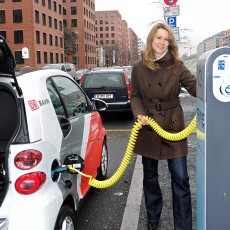
Companies can also opt for becoming member of a car sharing system. Doing so, they can reduce the need for corporate cars or add capacity to their own fleet as well as dispose of administrative and running costs, increasing mobility while removing the risks and hassle of owning and operating a carpool. This has been an option that Coca Cola Berlin has chosen, recently joining the Citroën Multicity e-car sharing fleet, operated by the eBRIDGE partner DB FuhrparkService.
But companies can also increase the efficiency of their own fleet by running their carpools in “car sharing mode”. The principles and technology of car sharing can be easily implemented and currently car sharing operators provide the operative platform and assistance to ease the management of corporate fleets. In 2013 DB FuhrparkGroup provided service to twelve company fleets, two of which electric, with a total of 12 EVs and around 500 users.
[1] Shaheen, S.; Cohen, A.; Chung, M. (2008). North American Carsharing: 10-Year Retrospective.


