Montag, 30 September 2026
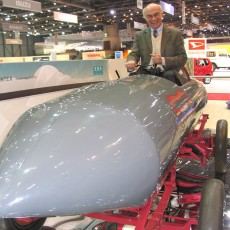
eBRIDGE interviews the famous Italian astronomer and President of CIVES Pietro Menga, who has been dedicated to the development of the electric cars in Italy for decades.
CIVES is the Italian branch of AVERE (European Associaton for Battery, Hybrid and Fuel Cell Electric Vehicles), created in 1978 by the initiative of the EEC Commission to study and promote the spread of electric vehicles for road use. AVERE is part of a worldwide network - the WEVA - World Electric Vehicle Association.
CIVES is an institutional non-profit organization, incorporated as a Special Commission of the Italian Electrotechnical Committee.
It is institutionally recognized as an organization that aggregates interests on electric vehicles, both on the supply side (vehicle manufacturers and components, producers and providers of electricity, research facilities, etc.) as well as the demand side (users of vehicle fleets, transport operators, professional associations, etc.).
Many public facilities such as the Ministries of Environment, Economic Development, Infrastructure and Transport, the Lombardy Region, the National Research Council, numerous municipalities and their agencies are involved with CIVES.
eBRIDGE has interviewed its President, Mr. Pietro Menga, an astronomer who has maintained a passion for the stars and for the asteroid search, but has been dedicated to the development of the electric car in Italy for decades.
Q: People have been talking about electric cars for some time, but the market does not seem to take off. How would you describe the situation?
A: At the international level - just look at Japan - the industry is showing great interest in the electric car, full electric or hybrid. Every car producer has at least one prototype of this type, ready to be released to the market.
In Europe, the reasons for this interest are twofold: the European Commission has imposed strong targets to cut emissions; the car industry believes in technological improvements in the near future, which will enable electric vehicles to compete in terms of performance.
In France and Germany the interest, even political, is very strong, and is driven by domestic car manufacturers. Italy is a case apart: Fiat’s interest in the electric car waned. The absence of a national player investing in this field leads to the fact that the national policy does not progress in this direction. It is a serious mistake; today in Italy we import 70% of cars, and it would be better to encourage the purchase of clean cars, even if foreign.
Q: From now on, what are the main actions to work to?
A: Today, electric vehicles offer lower performance compared to traditional cars and still do not entirely meet the customer needs. A technological leap is needed, and we are approaching that through hybrid cars with electric rechargeable batteries.
The second thing we need to overcome is the problem of the recharging infrastructure, to be disseminated in the public sphere, but also in private settings.
Finally, we need to get to the standardization: at a technological level, to ensure easy charging of vehicles anywhere via a standard plug; agreements between car manufacturers and energy companies need to be reached, similar to the ones between mobile phone companies, that allows data roaming across all the mobile networks even though you have a contract with only one of these companies.
Q: eBRIDGE was born with the idea of pushing for the introduction of electric cars in car fleets. What do you think of this approach?
A: It’s a good approach. CIVES dedicates all its efforts to the spread of electric cars but is afraid of all the counterproductive launches of not yet feasible initiatives as, for instance, the start up of fully electric taxi services in big cities.
We are aware it is important to start with the most productive and feasible initiatives and, from this perspective, to start to from fleets is a good idea. This is what they have been doing in France, monitoring all the biggest existing fleets and launching with the input of the Government a centralized mechanism for discounted purchase of 4-5 models of electric cars, setting the goal to replace most of the current fleet vehicles with new electric models.
Q: By the way, how does Mr. Menga prefer to move in its city, Milan, on his daily journeys?
A: I now prefer to move by public transport, but I have tested and used several electric cars since the ‘80s: I was literally seen by all people as a guinea pig!


